Friday, 8 March 2013

Meet...Nick and Lynne

Nick and Lynne Swanepoel are an amazing couple who have been working with the Rendille tribe in Korr for over 30 years. They first arrived here from South Africa with their young family at the time of the big East African famine of the 1980s. They came to do Bible translation but soon became involved in the distribution of food aid and animal restocking programmes. Doing this valuable work cemented in Nick and Lynne a deep love for the Rendille people and enabled them to win their trust (at first local people used to throw stones at them because many had never seen white people!).

Since then they have learned the language and developed it in written form for the first time. Nick works alongside two Rendille men in translating the Bible. So far they have translated most all of the New Testament books of the Bible and much of the Old. The Bible is the word of God, vital for showing all people what they are like, who God is and how he loves all people so much that he sent his son, Jesus, to earth to die, so that everyone who believes in him shall have eternal life. Having the Bible in their own language enables people to discover this for themselves and learn more about God’s character, his purposes and how we are to live in light of his great love and mercy.

But of course, to use the Bible folks need to read. And that is why Nick and Lynne also set up adult education progrmmes. A team of local people run adult classes in literacy, basic health, numeracy and animal care in the go’obs (villages). There are also go’ob nursery classes.

The translation, literacy, nurseries, primary schools and the secondary school where I teach are all part of the local church’s ‘Tirrim Project’. Tirrim is the Rendille word for the centre post in a min (traditional Rendille hut) that holds the house up and keeps it from blowing away. In the Bible Jesus is described as being the Tirrim, or cornerstone. The Project is so called because Jesus is at the centre of the work in Korr.

God has used Nick and Lynne wonderfully in Korr. They have witnessed many lives changed, both materially and spiritually. They no longer have stones thrown at them. Now they are honoured by the community. Though still poor, the Rendille Christians are rich in faith and love for the Lord. On Sundays the growing church is full and is led by local men. Many of the church leaders, translators and school teachers went to Tirrim schools or had school fees paid by the Project and it is great to see them seeking to serve God by helping others in their community.

It is a privilege to have got to know the Swanepoels, serve alongside them and be a small part of the work that God is doing through them in Korr. They have looked after me and welcomed me into their family. I spent Christmas with them, their son and daughter-in-law and four grandchildren (who are also missionaries in northern Kenya) and I have loved hearing their own (often humorous) stories of God’s love, sustenance and guidance.

Wednesday, 6 March 2013

Meet...the ladies

Sarah, Ruth, me, Faith, Martha, Mercy and Kulamo, Alice and Misha
These are some of the ladies from church who come over on a Saturday afternoon to practise English. The first week they came they taught us how to make proper Kenyan chai.

I've enjoyed getting to know these women and learning about their lives. They often bring along the smallest of their children which mean I get baby cuddles. As well as chatting, we pray and sometimes read the Bible together. And Martha recently asked if we can do some baking together one week...how cool is that?!


Sunday, 17 February 2013

Meet...Mama Jane

This is Mama Jane. She lives at school and helps look after the students who board, especially the girls and also has living with her a number of children who are extended family members or orphans. She lives in a semi-traditional min (Rendille hut) right next to the girls dorm which isn't far from my office.

She is a very special woman, with a big heart, big smiles and big hugs. So I visit often. And she has a nice clean choo (toilet) and often offers a cup of chai when I am there! She hasn't had an easy life but is nevertheless full of the joy that comes from knowing Jesus. She helps run the Sunday school and keeps the small kids in order during services, she takes a big part leading singing at church, and loves to speak to the students in their daily night devotions. Pray that God will keep her in good health and use her to bless those in her care. Also pray that her infectious joy will bring others to know, love and serve God.

Wednesday, 13 February 2013

Meet...Ngurunit

This is Ingurnit, our house help. She comes twice a week to do our laundry and some cleaning. She does the laundry by hand as we don't have a washing machine. It dries outside very quickly in the hot and windy conditions. (I am not completely spared the job of handwashing as I still have to do my undies!)

I find it very strange having someone work for me like this. I mean, I am perfectly capable of doing my own housework (although I'm not a big fan) and laundry. But it is customary, and almost expected, that westerners will hire local help. Not because we can't do things for ourselves but because in doing so we are able to help support local people support themselves. There are very few jobs in Korr and enabling people to work for money (rather than just giving handouts) is a way of serving them as well as getting to know local folks.

Ingurnit has five children and her husband is too ill to work. She works hard to feed them and keep them clothed and try and get her children through school. Housemate Christina teaches Dorcas, one of her daughters.

Despite her hardships, Ingurnit always has a big smile on her face. She has a great sense of humour which is vital as we try and communicate - mainly in gestures, acting and the few Rendille words that I have. It is always a joy to see her and take pride in her work! If I home we will enjoy a cup of chai together. She is always keen if we have cardboard boxes and string spare that she can use to repair her min (house).


Sunday, 3 February 2013

A walk through Kibera


Whilst I was in Nairobi in December I visited a Christian community-based development organisation called Ghetto Light. It is in Kibera, one of the largest shanty towns in Africa and located on the edge of the city. Run by Kenyan Christians, Ghetto Light helps some of the poorest city-dwellers by running activities for young people and by giving business advice and banking facilities to local entrepreneurs. A number of AIM workers are involved in youth and children's projects at Ghetto Light such as a preschool, football league and a dance squad.

Like so many of my Kenyan adventures, visiting Kibera was like stepping into a Geography textbook. I don’t want to be a tourist or a geography teacher when I visit places like this and as a result I didn’t take many photos. But as I walked through the narrow, bustling passageways I couldn't help considering an assignment that LCHS Year 13 Geographers write: Are slums places of hope or despair.

Slums of hope or despair?

Karla, an American nearing the end of her gap year in Kenya, took me on a walk around Kibera. Earlier in the year she had lived at Ghetto Light’s base and worked with the preschool. Kibera means forest and looked at from above it does look like a dense jungle of building. As we walked down towards the settlement and crossed the railway tracks that run through Kibera is built we were rather conspicuous ‘wazungus’ (white folks) but people were friendly and children were keen to greet us (in the hope that we might give them sweets, perhaps) and Karla knew some of them from her time working there.

 
Despair?

Conditions in Kibera are extremely poor, and most of its residents lack access to basic services, including electricity and running water. It was dry when I visited but I could easily imagine how slippery the paths would get if muddy. Open sewers run along the paths and when I was there some people were clearing out rubbish. Combined with poor diet and contaminated drinking water, this will inevitably lead to significant health issues.
 
Joyce, the house help where I stayed in Nairobi, told me that she lived in Kibera until a year ago. She talked fondly of it, but she found crime was on the increase and her house was broken into several times. A few days after she moved out her place burned down when a fire broke out nearby.
 
Life there is hard in so many ways that I can’t really imagine. Many people are born, live and die in Kibera, without ever leaving, despite the centre of Nairobi not being just 3 miles. Government slum clearance and development has happened with little regard for local people who can’t afford the rent in the new apartments and many move back to Kibera. Only the first phase of the redevelopment has occurred, partly because plans are beset by flooding, unstable slopes and people who steal building materials.

Hope?
Yet people we saw weren’t miserable or wallowing in self-pity.There were many people moving around like they had some place to be and there was lots of economic activity: little dukas (shops), people grilling maize or frying mandazi (like donuts) to sell, workshops making or recycling household items. There are small cafes, places to watch football and hairdressers.
 
With high underemployment and unemployment in Nairobi, residents couldn’t afford to pay regular rents in the formal housing sector so this is home, however basic, to around 100,000 people and they take some pride in the place. Kibera is divided into community areas based on tribal origins and this helps create community spirit.
 
Despite it being informal housing, the government are doing things to help such as putting in electricity, floodlighting and piped water. And they are attempting some slum clearance/redevelopment. Redevelopment in an area locally called ‘Canaan’ because of the promise that it held. Slums were cleared and new high rise apartments were built with the aim of providing basic, decent, affordable accommodation.
 
There are many schools, both government and private, in Kibera so children can go to school (primary education is supposed to be compulsory and free in Kenya). Many, many development agencies work in Kibera in different ways. Ghetto Light is just one example of the Christian work that is done. It seeks to not only see to people’s physical needs in improving their chances in life, but also their spiritual needs, sharing with them how the love of Jesus and a restored relationship with God can transform all aspects of their lives.


So, despair or hope? I think I will leave the conclusion to you, my reader, and Year 13s back home! Answers on a postcard (or the space below!)


Thursday, 31 January 2013

Goat

Last week some new teachers organised a staff gathering. They bought a goat and tied it to a tree in the school compound all day. Then they arranged for someone to slaughter it and cook it. A few hours later, after sunset, we sat outside under an acacia tree, drinking soda and talking politics whilst we ate roast goat, goat stew and ugali. Entrails were fortunately served separately.

Monday, 28 January 2013

Stones as 'toilet paper'?

I read on the BBC at the weekend that these pottery pieces, once thought to be Roman gaming pieces, are now believed to have been used for wiping bottoms. http://www.bbc.co.uk/news/uk-england-21204228 An interesting discovery!

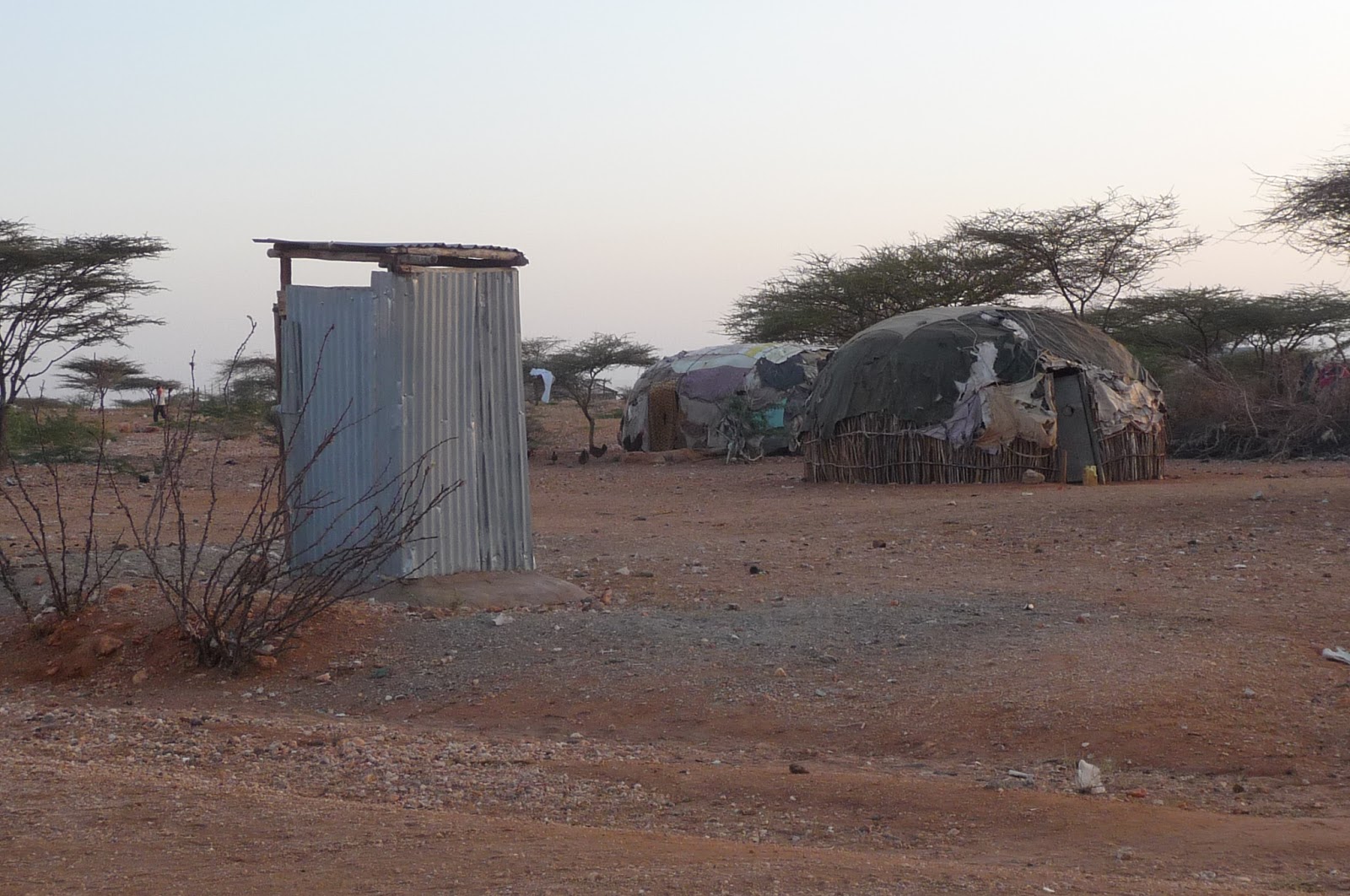
In the same way, some traditional folks in arid, rural, northern Kenya use stones in the absence of other suitable materials (paper, leaves etc). This practice has caused problems in the many pit latrines that have been dug in and around Korr, many by NGOs. Of course, decent toilets and sanitation are important for the health of locals. But it's not enough just to dig the toilet; there has to be accompanying instruction and provision of toilet paper as many toilets have been filled up with stones, rendering them unusable.